

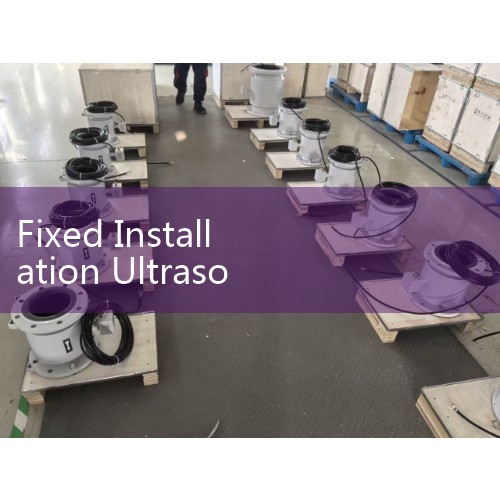
『Fixed Installation Ultrasonic Flow Meter Design: Permanent Transit-Time Meters for Water Plants』Related information(flow rotameter|digital flow meter|balo meter|hydraulic flow meter|volumetric meter|positive displacement meter|pitot tube flow meter|displacement meter|cfm meter|variable area flow meter|inline flow meter|differential pressure flow meter|calibrated flow meter|velocity meter|paddle wheel flow meter|oval gear flow meter|anemometer hvac|multiphase flow meter|doppler flow meter|thorpe tube flowmeter|heat flow meter)
Fixed Installation Ultrasonic Flow Meter Design: Permanent Transit-Time Meters for Water Plants
Quick Answer: A fixed installation transit-time ultrasonic flow meter gives water plants a permanent flow measurement tool for raw water, backwash, sludge, and clearwell lines. Choose clamp-on sensors for DN25 to DN1200 pipes where shutdown is not possible. Choose inline spool-piece meters for DN15 to DN50 lines that need higher accuracy and PT100 temperature output. Send your pipe size, water quality, and flow range to get a model from Silver Instruments.
Why Water Plants Choose Fixed Transit-Time Ultrasonic Meters
Water plants in Southeast Asia, Australia, and the Middle East handle many pipe sizes. Raw water intake pipes are often DN600 or larger. Backwash lines on sand filters are shorter. Chemical dosing lines are small, sometimes DN15 to DN25. A fixed installation transit-time meter covers these without cutting the pipe for most clamp-on models. No moving parts means less maintenance than turbine meters.
In practice, most engineers skip portable meters after a few audits. They want a permanent signal to SCADA, a totalizer for daily reports, and a meter that survives wet well humidity. A fixed ultrasonic meter mounted in a fiberglass enclosure does that.
Clamp-On vs Inline Spool-Piece Design
Clamp-on sensors mount outside the pipe. They measure flow through the pipe wall. This works on steel, ductile iron, HDPE, and some concrete pipes. Use clamp-on when the pipe is DN50 to DN1200 and shutdown is costly. Raw water with turbidity up to 500 NTU still passes clamp-on transit-time signals if the pipe is full and the wall is not heavily scaled.
Inline spool-piece meters have factory-installed transducers in a short pipe section. They suit DN15 to DN50 chemical lines, filter effluent sampling lines, and any place where a small error matters. Accuracy reaches 0.5 percent of reading. A built-in PT100 sensor reports water temperature at the same time.
Water Plant Application Examples
A customer in Vietnam uses a Silver Instruments clamp-on meter on a DN600 raw water intake line. The pipe is carbon steel, wall thickness 8 mm, water temperature 26 to 30 °C. The meter sends 4-20 mA HART to the plant SCADA. Installation took one morning without cutting the pipe.
A filter backwash line in a Philippine water district has only 8D of straight run before an elbow. The plant installed the clamp-on transducers in V mode at 45 degrees from top dead center. The meter reads backwash flow from 150 to 400 m3/h with repeatability better than 0.5 percent.
For a polyaluminium chloride dosing line in a desalination plant in Oman, an inline spool-piece meter on DN15 pipe measures 10 to 80 L/h. Standard clamp-on meters cannot measure this low flow. The spool-piece uses high frequency transducers and a 316L stainless steel body.
Key Design Parameters for Fixed Meters
Specify these values when you request a quote. Pipe size and material: give pipe OD and wall thickness for clamp-on models, process connection and pressure rating for inline spool-piece models. Water quality: raw water with high solids needs a lower frequency transducer. Flow range: minimum and maximum flow in m3/h or L/s affects transducer frequency and transmitter gain. Output: most plants order 4-20
_600x400.jpg)
Silver Instruments Fixed Ultrasonic Series
The SUT-2100 clamp-on meter covers DN25 to DN1200. Accuracy is 1.0 percent of reading, repeatability 0.2 percent. Transducers are IP67 and operate from -40 to 160 °C. The SUT-2200 inline spool-piece meter covers DN15 to DN50. Accuracy is 0.5 percent. Body materials include 316L stainless steel and carbon steel with PTFE liner. Pressure rating goes to PN40. The SUT-2300 insertion hot-tap meter handles DN200 to DN2000 and can be installed under pressure with a hot-tap kit.
Installation Rules That Prevent Bad Readings
Keep 10D upstream and 5D downstream straight run for clamp-on and inline transit-time meters. If the nearest upstream fitting is a control valve, increase to 20D. Install on a vertical pipe with upward flow when possible. The pipe must always be full.
For clamp-on sensors, clean the pipe surface to bare metal. Apply couplant evenly. Tighten the mounting bands in a crisscross pattern. Many bad readings come from loose sensors or air gaps under the transducer face.
For inline spool-piece meters, install the meter with the flow arrow pointing downstream. Ground the spool if the body is carbon steel. Keep the transmitter away from variable frequency drives and large motors.
Need a fixed installation ultrasonic flow meter for a water plant? Send us your pipe OD, wall thickness, water quality, flow range, and pressure. Tel: +86-25-68650347, Whatsapp: +86-25-52155837, WeChat: +86 15365082610.
FAQ for Water Plant Ultrasonic Meter Design
Can a fixed clamp-on ultrasonic meter work on old ductile iron or concrete pipes?
Yes in many cases. Ductile iron with internal cement lining works well if the lining is smooth. Old concrete pipes with voids or delamination can block the ultrasonic signal. Test one spot before permanent installation. If signal strength is below 30 percent, switch to an inline spool-piece meter.
Do transit-time ultrasonic meters need a minimum water conductivity?
No. Unlike electromagnetic flow meters, transit-time ultrasonic meters do not use conductivity. Potable water, raw water, demineralized water, and some filtered process water can be measured. High air bubbles or solids above 5 percent can weaken the signal.
What straight run do I need for a permanent ultrasonic meter in a water plant?
Plan 10D upstream and 5D downstream from the nearest valve, elbow, or pump. For a DN200 line, that means 2.0 m straight pipe before the meter and 1.0 m after. For control valves or partially open gate valves, use 20D upstream.
Can I install a fixed ultrasonic meter on a vertical pipe?
Yes. Choose a vertical pipe with upward flow. The pipe must be full. This setup helps air bubbles rise and gives better signal in raw water and sludge lines. Do not install on a downward flow pipe.
Which outputs should I specify for SCADA and local totalizer?
Most water plants use 4-20 mA HART for flow rate, RS485 Modbus RTU for digital data, and one pulse output for totalizer. Some sites add a relay output for empty pipe alarm. Silver Instruments supplies all these on the standard transmitter.
 Hot Product
 Related AD