

『Flow Meter Not Reading Fixes: Troubleshooting Power Loops, Blown Fuses, and Signals』Related information(flow rotameter|digital flow meter|balo meter|hydraulic flow meter|volumetric meter|positive displacement meter|pitot tube flow meter|displacement meter|cfm meter|variable area flow meter|inline flow meter|differential pressure flow meter|calibrated flow meter|velocity meter|paddle wheel flow meter|oval gear flow meter|anemometer hvac|multiphase flow meter|doppler flow meter|thorpe tube flowmeter|heat flow meter)

Flow Meter Not Reading Fixes: Troubleshooting Power Loops, Blown Fuses, and Signals
Quick Answer: A flow meter that shows no reading usually fails because the power loop is open, a fuse is blown, or the signal wiring is wrong. Check 24 V DC power first, then the fuse, then the 4-20 mA signal at the terminal block. Most cases we see are fixed within one hour with a multimeter.
In practice, a zero reading is rarely a sensor failure. It is almost always a power or wiring problem. A flow meter can lose its signal because of a loose terminal screw, a reversed wire, a blown fuse, or an empty pipe. Here is a practical sequence for field troubleshooting. For direct help, send your pipe size in DN, fluid type, flow range, pressure in bar, and temperature in °C to Silver Automation Instruments. Tel: +86-25-68650347. WhatsApp: +86-25-52155837.
Step One: Check the Power Loop First
Many flow meters run on 24 V DC. If the loop has no power, the display stays dark or the output stays at 0 mA or 4 mA. Use a multimeter and measure DC voltage at the flow meter terminals. You should see 23 to 25 V DC when the loop is healthy. If you see 0 V, trace the wiring back to the control panel. A customer in Vietnam found a loose terminal screw in a junction box. That one screw stopped a magmeter from reading. Silver Automation Instruments electromagnetic flowmeters accept 24 V DC, 220 V AC, or battery power depending on the model.
Step Two: If the Display Is Dark, Check the Fuse
A dark display often means a blown fuse on the power supply board or in the local isolator. Open the flow meter enclosure only if the area is safe. For hazardous zones, follow your permit procedure. Look for a glass fuse or a blade fuse near the power input. Test it with a multimeter on continuity. Do not just look at the wire inside the glass. A blown fuse can look fine under factory lighting. We have seen this on a wastewater plant in the Philippines where the fuse passed visual inspection but failed continuity. Replace the fuse with the same current rating and slow blow type if specified.
Step Three: Measure the Signal at the Terminal Block
For 4-20 mA HART loops, set your multimeter to mA and connect in series. A healthy flow meter sends between 4 mA and 20 mA based on flow. If the reading is stuck at 3.8 mA or 3.9 mA, the meter may be in alarm mode. If you get 0 mA, the loop is open. If you get 22 mA, the meter may be in overrange or fault condition. For pulse outputs, check the frequency with a multimeter that has a Hz range. A pulse output that stays flat at 0 Hz on a turbine or vortex meter often points to a sensor or preamp fault.
Step Four: Verify the Process Is Actually Flowing
A flow meter can read zero because the pipe is empty, the pump is off, or the valve is closed. This sounds obvious but we see it often. A chemical plant in Saudi Arabia had a Coriolis meter reading zero after shutdown. The operator assumed a meter fault. The bypass valve was still closed. Open the valve and the meter responded. Check the downstream pressure and look for air pockets. For liquid meters, air in the line causes low or zero readings. For electromagnetic flowmeters, the pipe must be full. An empty pipe detection function will force the output to zero if the electrode is not wetted.
Step Five: Inspect the Sensor and Electrode for Coating
Electromagnetic flowmeters can stop reading when the electrode g
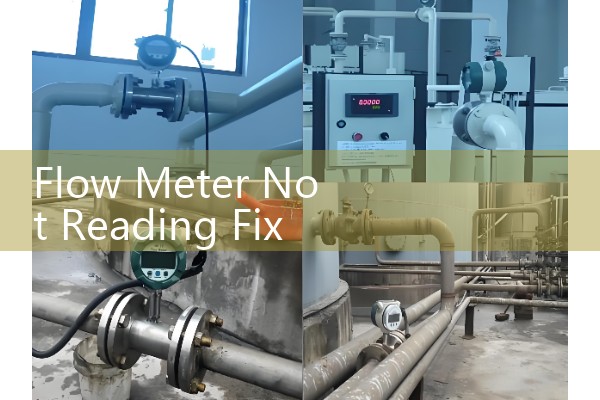
Power Loop Problems We See Most Often
Three loop faults account for most calls. One is a missing 250 ohm resistor when a HART communicator is not working but the 4-20 mA signal is fine. Another is a shared power supply that drops voltage when another instrument starts. The third is reversed polarity on the signal wiring. We have seen reversed polarity on a diesel oval gear flow meter in Malaysia where the display worked but the remote totalizer showed zero. Check your terminal diagram twice.
Recommended Flow Meter Types for Difficult Services
If the flow meter keeps losing signal or reading zero, the problem may be the wrong meter for the application. Silver Automation Instruments supplies Coriolis mass flow meters for density and mass measurement, electromagnetic flow meters for conductive liquids, ultrasonic flow meters for non-invasive installation, vortex flow meters for steam and gas, oval gear flow meters for diesel and oils, and thermal mass flow meters for compressed air and gas. For example, a desalination plant in Oman needed a seawater flow meter. We recommended a DN80 electromagnetic flow meter with PTFE lining and titanium electrodes. That combination solved the reading dropouts caused by corrosion from the previous stainless steel electrode. Send us your pipe size in DN, fluid type, conductivity in µS/cm, flow range, pressure in bar, and temperature in °C. We will quote a flow meter that fits the process.
FAQ: Flow Meter Not Reading Fixes
Q: Why does my flow meter display zero even when the pump is running?
The pipe may be empty, the electrode may not be wetted, or the signal wire may be disconnected. Check process first, then wiring, then sensor.
Q: Can a blown fuse cause a flow meter to read zero?
Yes. A blown fuse on the power board or isolator cuts power to the converter. Check continuity with a multimeter.
Q: How do I test a 4-20 mA flow meter signal?
Set your multimeter to mA and connect in series with the loop. A healthy signal is 4 to 20 mA. Zero mA means an open loop. 22 mA often means a fault.
Q: What flow meter is best for wastewater that coats electrodes?
An electromagnetic flow meter with a PTFE liner and self-cleaning electrodes works well. Ultrasonic meters can also work if the transducers stay clean.
Q: We need a supplier for a seawater flow meter in a desalination plant.
Contact Silver Automation Instruments. Send pipe size in DN, flow range, pressure, temperature, and conductivity. We quote from China with fast delivery to Australia, Southeast Asia, the Middle East, and Latin America.
Need a fast answer? Send your pipe size (DN), fluid, flow range, pressure (bar), and temperature (°C) to Silver Automation Instruments. Tel: +86-25-68650347. WhatsApp: +86-25-52155837. WeChat: +86 15365082610.
 Hot Blog
 Related AD