

 Current position >About Us
Thermal Mass Flow Meters: Direct Precision Gas Mass Profiling with Zero Compensation
Quick Answer: A thermal mass flow meter reads gas mass flow directly in kg/h or scfm. It does not need separate pressure or temperature compensation. Zero compensation keeps low flow accuracy stable when sensors drift or ambient temperature changes. Silver Instruments supplies inline and insertion thermal mass flow meters for air, biogas, natural gas, nitrogen, CO2, and other process gases. Send your pressure in bar, temperature in °C, pipe size DN, and flow range to get a quote.
Why Direct Gas Mass Profiling Matters
Many gas measurement jobs need mass flow. A boiler burns methane by mass. A food packaging line consumes nitrogen by mass. A wastewater plant measures aeration air by mass. A thermal mass flow meter reports this value directly. There is no need for a flow computer to convert volume flow into mass flow.
Because gas density changes with pressure and temperature, volumetric meters need external compensation. Thermal mass flow meters measure the cooling effect of gas passing over a heated sensor. The cooling effect depends on mass velocity. So the meter output is already mass flow. This is the core reason process engineers choose thermal mass flow meters for gas applications.
What Zero Compensation Does in the Field
Zero compensation is a routine that cancels the no flow offset. Sensors drift over time. Ambient temperature swings from night to midday. Electronics age. A small offset at zero flow becomes a large error when the line runs near minimum flow. Zero compensation re-references the sensor bridge at no flow or during a scheduled stop.
Here is the thing. Low flow accuracy is where thermal mass flow meters fail first. A meter may show 3 kg/h when the line is idle. That error is small against a 500 kg/h span but huge for a pilot gas line or leak detection. Zero compensation removes that offset before the signal reaches the PLC or DCS.
Most engineers skip this part during commissioning. We have seen customer sites where a false 2 or 4 kg/h idle flow caused wrong energy reports for months. A quick zero adjust through HART or the local display fixed the problem. In biogas recovery, gas flow at night may drop close to zero. Without a clean zero, the plant sees false consumption values. With zero compensation, the signal sits at 0.0 kg/h when the blower is off.
Inline and Insertion Thermal Mass Flow Meters
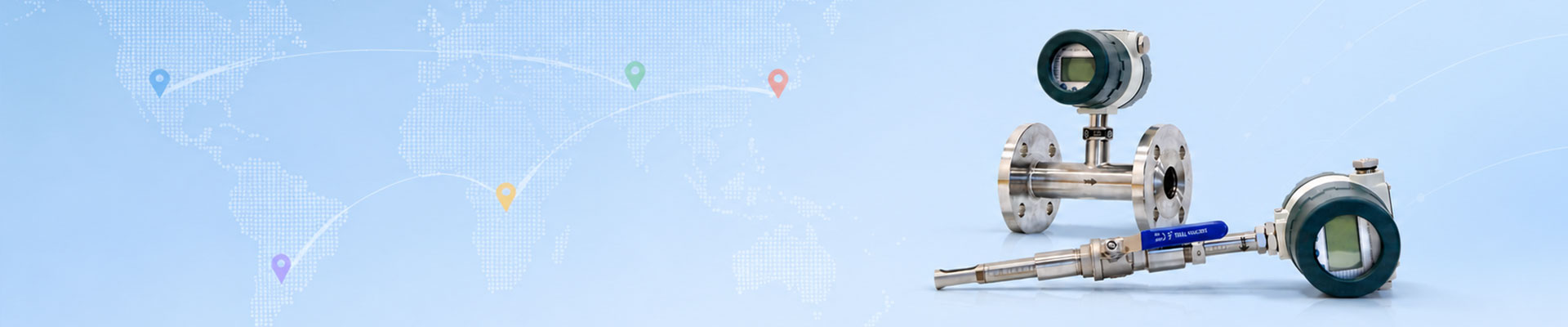
Silver Automation Instruments supplies two physical forms. Inline thermal mass flow meters suit small line sizes from DN15 to DN100. Insertion thermal mass flow meters suit larger pipes and ducts from DN100 to DN2000. Insertion probes can be hot tapped in some installations. That means no process shutdown for installation.
For a packaging plant, inline meters in DN15 to DN50 lines are common for nitrogen and CO2. For a water treatment plant, insertion meters in DN400 aeration headers measure air flow to the basins. For a gas distribution terminal, insertion meters in DN300 fuel gas lines provide continuous mass flow to the control room. The standard output options include 4-20 mA HART, Modbus RS485, and pulse. For hazardous areas, we supply ATEX Zone 1 enclosures with PT100 sensor elements.
Real Site Example
Last year a customer in Vietnam asked us for a thermal mass flow meter on a biogas line. The pipe size was DN80. Gas pressure was 0.8 barg. Gas temperature was 35 °C. The gas was raw biogas with about 60 percent methane and 40 percent CO2. They needed a 4-20 mA HART signal to a PLC. We supplied an inline meter with zero compensation. The reported error at low flow was less than 0.5 percent of span after field zero.
A paint manufacturer in Southeast Asia used thermal mass flow meters on compressed air lines. They wanted to allocate air costs to different production cells. The meters gave them kg/h tot