

 Current position > News detail
『Bellows Flow Meter: Sourcing Differential Pressure Gas Diaphragm Submeters』Related information(flow rotameter|digital flow meter|balo meter|hydraulic flow meter|volumetric meter|positive displacement meter|pitot tube flow meter|displacement meter|cfm meter|variable area flow meter|inline flow meter|differential pressure flow meter|calibrated flow meter|velocity meter|paddle wheel flow meter|oval gear flow meter|anemometer hvac|multiphase flow meter|doppler flow meter|thorpe tube flowmeter|heat flow meter)
Bellows Flow Meter: Sourcing Differential Pressure Gas Diaphragm Submeters
Quick Answer: A bellows flow meter uses a flexible gas diaphragm to measure differential pressure across an orifice or flow element. Silver Automation Instruments supplies bellows type DP gas submeters for custody transfer, burner control, and process gas measurement at competitive factory prices. Typical models handle pressures up to 40 bar and temperatures from -20 °C to 120 °C.
What Is a Bellows Flow Meter and Where Does It Fit
A bellows flow meter is a differential pressure instrument. It measures gas flow by sensing the pressure drop across a primary element such as an orifice plate, venturi, or flow nozzle. The bellows element converts the pressure difference into mechanical motion. That motion drives an indicator, a transmitter, or a totalizer.
Gas utilities use bellows DP meters for submetering applications. Landlords in Australia install them to bill individual tenants for natural gas. Factories in Vietnam use them on compressed air branch lines. A chemical plant in Saudi Arabia may run them on nitrogen distribution headers. The meter body is typically cast aluminum or stainless steel. The diaphragm is usually Buna-N, Viton, or stainless steel depending on the gas.
Many engineers compare bellows meters with electronic DP transmitters. Both measure differential pressure. But a bellows meter is self-contained. It needs no power supply. It needs no I/O wiring. That simplicity matters on remote wellheads in Papua New Guinea or in a crowded utility closet in a Manila high rise.
How a Bellows DP Gas Diaphragm Meter Works
The operating principle is straightforward. Gas flows through a restriction. The restriction creates a high pressure side and a low pressure side. Two impulse lines connect the pipe taps to the meter body. Inside the meter, a bellows or diaphragm assembly sits between the two pressure chambers.
Higher pressure pushes the bellows inward. Lower pressure allows it to expand outward. The bellows moves a linkage. The linkage turns a pointer on a dial or drives a pulse output. In some designs, a second bellows compensates for static pressure changes. That keeps the reading stable when line pressure moves up or down.
This design works well for low to medium flow rates. Gas submetering is a typical role. The accuracy is usually 1.0 percent to 2.5 percent of full scale. That is enough for billing, allocation, and plant monitoring. It is not a custody transfer device for high value hydrocarbon sales. For that job, a Coriolis mass flow meter or an ultrasonic flow meter makes more sense.
Common Models and Spec Ranges We Supply
Silver Automation Instruments sources bellows flow meters in several configurations:
DN15 to DN100 process connections. Threaded BSP or NPT for small sizes. ANSI 150 or PN16 flanges for larger bodies. Pressure ratings from 6 bar to 40 bar depending on the housing material. Ambient temperature range from -20 °C to 60 °C. Gas temperature range from -20 °C to 120 °C. Wetted materials include aluminum alloy, 304 stainless steel, and 316L stainless steel. Diaphragm choices include NBR, EPDM, Viton, and 316L stainless foil.
Output options are local indication only, 4-20 mA two-wire, or pulse output for remote totalizing. Some units include a PT100 input for temperature compensation. That turns the raw DP signal into a corrected volume or mass flow reading. Buyers often ask for explosion proof housings. We can supply ATEX Zone 1 and IECEx certified versions for gas group IIC.
Here is a spec table engineers send us for quote requests:
Gas type: natural gas, compressed air, nitrogen, biogas, LPG, or oxygen
Flow range: minimum and maximum in Nm³/h or kg/h
Line pressure: nominal and maximum in bar or kPa
Gas temperature: expected range in °C
Pipe size and connection type: DN15 BSP, DN50 ANSI 150 flange, etc.
Output required: local dial, 4-20 mA, pulse, or RS485 Modbus
Hazardous area: none, ATEX Zone 1, or ATEX Zone 2
Material preference: aluminum, 304 SS, or 316L SS
In practice, most customers send us the flow range and line pressure first. We then recommend a primary element size and a meter body range. The orifice bore calculation is included in our quotation. You do not need a separate engineering study for standard pipes from DN15 to DN100.
Installation Notes That Prevent Field Problems
Straight pipe runs matter. The orifice plate needs stable flow to produce a clean differential pressure. Typical upstream straight run is 10D to 20D. Dow
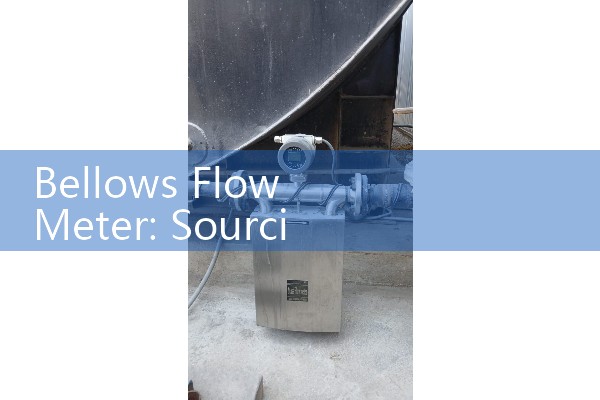
Impulse lines must slope upward for wet gases. Condensate can collect in the lines and cause false readings. Use a drip leg and drain valve when the gas carries moisture. Biogas from anaerobic digesters is a classic case. The gas is saturated with water vapor at 35 °C. Condensate blocks impulse lines within weeks. A bellows meter with diaphragm seals is the better choice for biogas service. Or install a gas dryer upstream.
Pulsating flow is another field problem. Reciprocating compressors create pressure pulses. The bellows assembly responds to the pulses and the pointer oscillates. You can install a snubber or needle valve in the impulse line to damp the signal. We have seen this on a compressed air system in a Jakarta textile plant. The meter dial was shaking so hard the operator could not read it. A simple damping valve solved it in one afternoon.
Price Range and Factory Lead Time
Bellows flow meter prices depend on size, material, and options. A basic DN25 aluminum body unit with local dial costs around 180 to 350 USD. A DN50 stainless steel version with 4-20 mA output and ATEX certification runs 600 to 1200 USD. Large DN80 or DN100 flanged meters with pulse output and temperature compensation can reach 1800 to 3000 USD. These are FOB China prices from our factory partners in Jiangsu and Shanghai.
Lead time is typically 7 to 15 working days for standard models. Custom ranges and exotic diaphragm materials add 10 to 20 days. Air freight to Australia, Vietnam, or the UAE takes 5 to 8 days. Sea freight takes 15 to 30 days depending on the destination port. We ship to Manila, Jakarta, Bangkok, Dubai, Jeddah, Arica, Callao, and Lagos regularly.
Payment terms are flexible. We accept T/T bank transfer with 30 percent deposit and 70 percent before shipment. Larger orders over 5000 USD can use L/C at sight for some countries. For repeat buyers in Southeast Asia and the Middle East, we offer 30 day account terms after three completed orders.
FAQ
What is the difference between a bellows flow meter and a standard DP transmitter?
A bellows flow meter is mechanical and self-powered. A DP transmitter is electronic and needs 24 VDC plus a signal loop. The bellows unit shows flow on a local dial without any wiring. A DP transmitter sends a 4-20 mA signal to a PLC or SCADA system. Both measure the same pressure drop from an orifice.
Can a bellows flow meter handle biogas from an anaerobic digester?
Yes, but choose the right diaphragm material. Biogas contains hydrogen sulfide and moisture. NBR and EPDM degrade quickly. Use Viton or 316L stainless steel foil diaphragms. Also install a condensate trap on the impulse lines. The gas is wet and will clog the lines if you ignore this.
Do I need a flow computer for temperature and pressure compensation?
Not always. If the gas pressure and temperature are fairly stable, a fixed correction factor works fine. If the gas density varies a lot, you need compensation. Some bellows meters include a built in PT100 input and a simple flow computer. Or you can send the 4-20 mA signal to a PLC and do the math there.
What is the minimum flow rate a bellows meter can detect?
Typical turndown is 3 to 1 or 4 to 1. That means the minimum readable flow is about 25 to 33 percent of full scale. Below that the bellows deflection is too small for accurate reading. If you need 10 to 1 turndown, use an electronic DP transmitter or consider a thermal mass flow meter for small gas flows.
How do I request a quote from Silver Automation Instruments?
Send us your gas type, flow range in Nm³/h, line pressure in bar, gas temperature in °C, pipe size (DN), and whether you need a local dial or 4-20 mA output. Our application engineers will select the model, calculate the orifice bore, and return a quotation within 24 hours. Contact us via Tel: +86-135-1213-1526, Whatsapp: 86-135-12131526, or WeChat: +86 13512131526.
Most engineers skip this part. They ask for a generic price list. But a bellows flow meter without a calculated orifice bore is useless. The DP range must match the orifice and the flow range. Send us the data above and you get a complete solution, not just a hardware price.