

 Current position > News detail
『Kegerator Flow Meter: Sanitary Beverage Line Draft Beer Counter Gauges』Related information(flow rotameter|digital flow meter|balo meter|hydraulic flow meter|volumetric meter|positive displacement meter|pitot tube flow meter|displacement meter|cfm meter|variable area flow meter|inline flow meter|differential pressure flow meter|calibrated flow meter|velocity meter|paddle wheel flow meter|oval gear flow meter|anemometer hvac|multiphase flow meter|doppler flow meter|thorpe tube flowmeter|heat flow meter)
Kegerator Flow Meter: Sanitary Beverage Line Draft Beer Counter Gauges
Quick Answer: A kegerator flow meter measures beer volume and flow rate directly in the draft line between the keg coupler and the faucet. Silver Automation Instruments supplies sanitary inline counter gauges with 316L stainless steel bodies, tri-clamp ends, and 0.5% accuracy for beverage dispensing. Send your pipe size, flow range, and output signal to get a specific model and price.
Draft beer lines in bars, breweries, and restaurants need better visibility than just reading keg pressure. A kegerator flow meter on the beverage line shows how many liters have passed, when a keg is nearly empty, and whether the line has leaks or gas breakout. We have seen customer sites in Australia and Vietnam where one counter gauge replaced manual keg tapping records. Operators stopped guessing inventory and reduced warm beer waste at the faucet.
The term draft beer counter gauge often covers two jobs. It gives a local totalizer readout and sends a pulse signal to a remote display or POS system. In practice, most engineers prefer a pulse output for total volume and a 4 to 20 mA signal for flow rate trend. A kegerator flow meter must be compact because space behind a bar or under a counter is tight. It also must be easy to open for cleaning.
Sizing and Materials for Beverage Lines
For most kegerator and draft dispense lines, start with DN15 or 1/2 inch connections. The typical flow range for a single faucet is 0.4 to 10 liters per minute. Beer temperature sits around 2 to 4 °C during dispensing. The meter body should be 316L stainless steel. Wetted seals should be EPDM or Viton. Avoid brass or aluminum because beer is acidic and cleaning chemicals attack those metals. A polished wetted surface of Ra 0.8 µm or better reduces beer stone buildup and makes CIP rinse cycles faster.
Pressure rating matters less than you think. Most kegerators run at 0.7 to 2.5 bar. A meter rated to 10 bar covers draft beer, nitro dispense, and short cleaning chemical exposure. Check that the pulse output works at low flow. Some cheap plastic paddle meters stall at 0.5 L/min. Choose a sanitary oval gear or sanitary turbine flow meter that starts at 0.2 L/min or lower. This prevents undercounting when a bartender pours a half glass.
Output Signals and Remote Counting
Silver Instruments kegerator flow meters usually come with pulse output as the default. The pulse scale can be set at 100 or 500 pulses per liter depending on the counter display. For longer cable runs or control panels, 4 to 20 mA or RS485 Modbus is available. A 24 V DC loop-powered version saves wiring in a crowded bar backroom. Before ordering, confirm whether the counter gauge must show local total only or send data to a brewery management system.
Here is the thing about draft beer counters. The pulse value must match the input of the display. If the display expects 200 pulses per liter and the meter sends 100, the total will be wrong by half. We always ask customers to share the display brand or the input constant before shipping. It avoids a lot of onsite calibration back and forth.
Sanitary Design and Cleaning
A kegerator flow meter sits in the product path. That means it must handle not only beer but also line clean
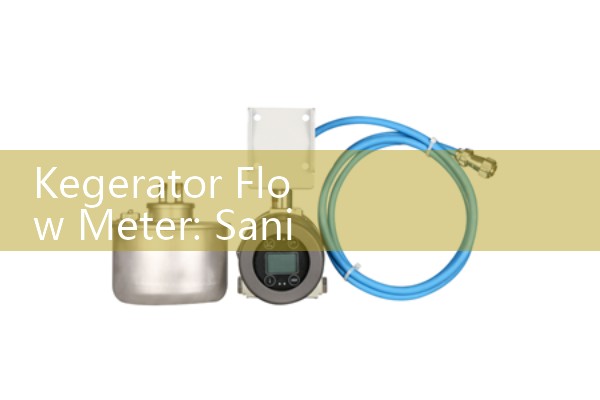
Most engineers skip this part. They buy a general water meter, install it in a cold beer line, and then wonder why the display drifts. Beer has dissolved CO2. When pressure drops across a flow meter, gas can break out and cause bubbles. A sanitary beverage flow meter with a smooth flow path and short body length reduces pressure drop. It also counts more stable when the keg is cold and the back pressure is set correctly.
Recommended Models and Ordering Data
For a single kegerator or draft beer tower, we often recommend the Silver Instruments SI-BF015 sanitary beverage flow meter. It has a 316L body, DN15 tri-clamp ends, EPDM seals, pulse output, and a measuring range of 0.2 to 10 L/min. For multi-line beer walls or brewery batching, a compact sanitary turbine model with RS485 output works better because many meters can share one data bus.
If you dispense nitro beer, cold brew coffee, kombucha, or cider, tell us the viscosity. Oval gear meters perform well on liquids up to about 100 cP. Most draft beer sits below 5 cP, so either oval gear or turbine works. We have supplied meters to a kombucha taproom in Southeast Asia where the totalizer helped track keg yield per flavor. That data changed their weekend production schedule.
What to Send for a Quotation
Do not send a generic contact form only. For a fast kegerator flow meter quote, send these details: pipe size or hose ID, flow range in liters per minute, liquid type, operating temperature, output signal needed, and display voltage. If you already have a counter display, include the pulse constant. Send these details by WhatsApp or call Tel: +86-135-1213-1526. Whatsapp: 86-135-12131526. WeChat: +86 13512131526.
Silver Instruments ships small sanitary flow meters to Australia, New Zealand, Southeast Asia, and the Middle East. We keep standard DN15 beverage meters in stock for quick dispatch. Custom pulse scaling or special seal materials may add a few days of production time.
FAQ
Q: Can a kegerator flow meter handle cold beer at 2 °C?
A: Yes. Wetted parts and electronics are rated for 0 to 60 °C. The pulse output stays stable at low beer temperature.
Q: What flow range should I order for a single draft faucet?
A: A range of 0.2 to 10 L/min covers most direct draw and long draw kegerator lines. For high flow filling stations, use a DN20 meter.
Q: Is the meter safe for food contact?
A: The body is 316L stainless steel and the seals are EPDM or Viton. The wetted surface is polished to Ra 0.8 µm for easy cleaning.
Q: Does it show total volume and flow rate?
A: The local display can show total liters and instant flow rate. Pulse or 4 to 20 mA outputs send the same data to a remote counter or PLC.
Q: Can it be used during line cleaning with chemicals?
A: Yes for short CIP cycles. Confirm the chemical concentration and temperature so we can check seal compatibility before you order.